





ti&m Live webinar
Creating an accessible and collaborative data platform with Open Datastack
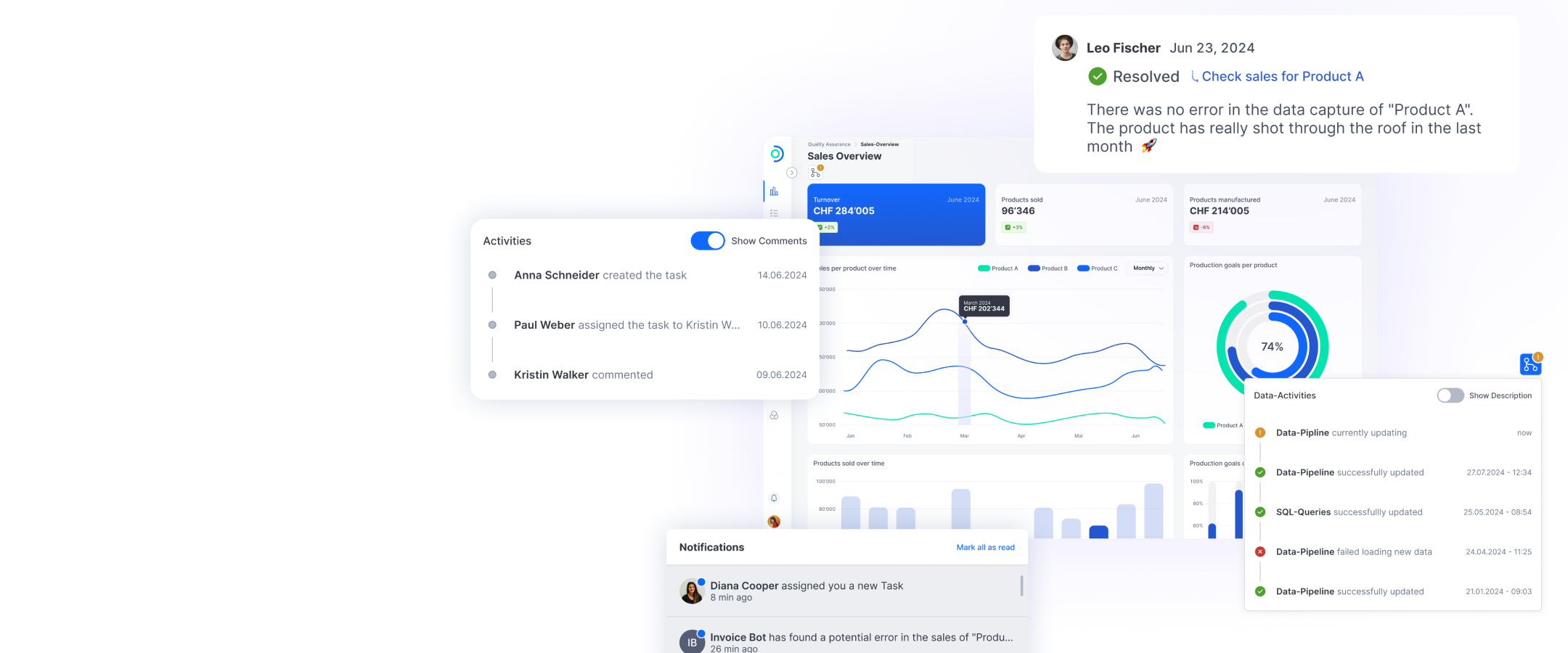
Traditional data platforms are often complex and not very user-friendly. This makes data difficult to access or find, significantly hindering fast, data-driven decision-making. Users often struggle to identify and effectively utilize relevant data because the platforms are not intuitively designed or are overloaded with unnecessary features. Frequently, data must be exported, for example, to Excel files, which then have to be forwarded to the desired recipients via email. This leads to uncontrolled data distribution within the company, and data accuracy is no longer guaranteed.
Overall, established reporting solutions have seen little innovation in recent years. Their core functionality has remained largely unchanged. At the same time, logic and data are often locked within the respective solution and protected by artificial barriers. The data processing logic often has to be built using proprietary technologies, making migration virtually impossible. This creates a dependency on vendors and their technologies, while simultaneously increasing the risk that the solution in use will no longer meet the company's needs in the long run.
Open Datastack addresses these problems by doing many things differently than traditional solutions:
- It combines widely used open-source technologies and integrates them into a unified, user-friendly interface.
- It offers collaborative features to significantly reduce the need for data exports.
- All the logic, from data preparation to reporting, can be implemented using open standards and technologies.
This webinar is aimed at companies that want to design an accessible and future-proof analytical data platform to create a solid and flexible foundation for current and future requirements, such as the use of artificial intelligence.
Creating an accessible and collaborative data platform with Open Datastack

Marketing Expert
Svenja Goltz
Any questions about our events?
We’d love to hear from you.